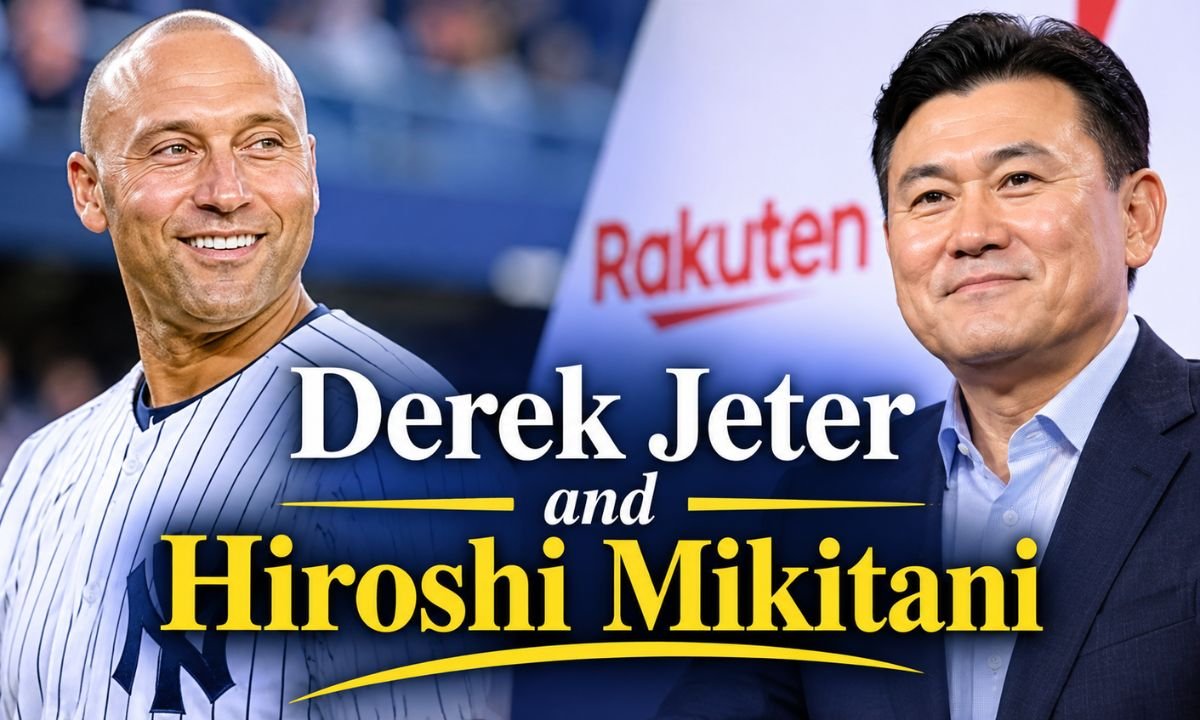
Ever wondered how a Yankees legend meets a tech founder? The story of Derek Jeter and Hiroshi Mikitani answers that. It all starts with Masahiro Tanaka. His 2014 move to New York tied two different worlds together. No friendship exists here. Yet the link still fascinates baseball fans everywhere today.
Here’s what you’ll discover. You’ll meet each man and see his biggest wins. You’ll watch Rakuten, the Golden Eagles, and the Yankees collide. You’ll learn how the posting system and its fees worked. You’ll also get a clear verdict on the facts. Grab a coffee and settle in. The ride takes only a few minutes.
Who Is Derek Jeter?
Think baseball royalty and one name pops up fast. Derek Jeter spent two decades in pinstripes. He became the face of the New York Yankees. His baseball leadership set the standard. Fans still call him “The Captain” today.
Jeter’s professional baseball career won him respect everywhere. He matters to this story for one reason. A Japanese baseball pitcher landed in his clubhouse. That pitcher links him to Rakuten. Keep reading to see how.
Early Life and Path to the Yankees
Jeter was born in Pequannock, New Jersey. He grew up in Kalamazoo, Michigan, dreaming of shortstop glory. The Yankees picked him in the 1992 MLB Draft. He made his 1995 MLB debut three years later. Few prospects ever climb that fast.
A Career Built on Leadership and October Moments
In 1996 Jeter won the American League Rookie of the Year Award. The Yankees also won the World Series that year. Jeter finished with 3,465 career hits. He earned 14 All-Star selections and five Gold Glove Awards. He also lifted five World Series championships.
Life After Baseball
Jeter retired after the 2014 season. The Baseball Hall of Fame elected him in 2020. He earned 396 of 397 votes. He also founded The Players’ Tribune in 2014. Later he led the Miami Marlins as CEO. His sports industry influence kept growing.
Don’t Miss: Richard Liu and Roger Federer: Their Journey, Achievements, and Fortune
Who Is Hiroshi Mikitani?
Now meet a very different kind of champion. Hiroshi Mikitani built a digital empire from scratch. He founded Rakuten, a giant in e-commerce business. His story shows how corporate entrepreneurship can reshape markets. Few founders match that reach.
Sports became part of that story too. Mikitani launched a team of his own. He stepped into Japanese professional baseball. That choice set up the Jeter and Mikitani link. It also created a path to New York.
From Banker to Founder
Mikitani was born in Kobe, Japan, in 1965. He studied at Hitotsubashi University and worked in banking. He then earned an MBA from Harvard Business School in 1993. The 1995 Kobe earthquake changed his direction. He left banking soon after.
How Rakuten Took Off
Mikitani launched Rakuten in 1997 with three partners. They started with about $250,000 in funding. The model helped merchants build their own online stores. That focus fueled global business expansion. Acquisitions and digital services followed. Rakuten soon became a Japanese giant.
Englishnization and Baseball Ambitions
In 2010 Mikitani made English Rakuten’s official language. People call this Englishnization. It was a bold 2010 corporate language policy. He also created the Tohoku Rakuten Rakuten Golden Eagles in Sendai. The team won its first Japan Series title in 2013.
The Connection Between Derek Jeter and Hiroshi Mikitani
So how do Derek Jeter and Hiroshi Mikitani connect? One pitcher answers it all. Masahiro Tanaka left Rakuten for the Yankees in January 2014. That international player transfer put both men in one story. Nothing else ties them.
Think of Tanaka as a bridge. Jeter stands on one bank. Mikitani stands on the other. The professional sports connection is real but indirect. No documented friendship or partnership exists. Honest facts beat flashy guesses.
The Short Answer
Here’s the quick version. Masahiro Tanaka links Jeter and Mikitani. He pitched for Mikitani’s Golden Eagles. He then signed with the Yankees. That one cross-border sports transaction explains the pairing. It’s a simple but powerful link. Everything else is speculation.
January 2014: The Deal That Tied Jeter and Mikitani Together
The 2013 season made Tanaka a star. He went 24–0 with a 1.27 earned run average. The Yankees offered a seven-year MLB contract. It was worth $155 million. They also paid Rakuten a $20 million posting fee. Baseball contract negotiations moved fast.
| Detail | Fact |
| Player | Masahiro Tanaka |
| 2013 record | 24–0 with a 1.27 ERA |
| Contract | Seven years, $155 million |
| Posting fee | $20 million paid to Rakuten |
| Receiving team | New York Yankees |
| Releasing team | Tohoku Rakuten Golden Eagles |
Case Study: Tanaka’s Path From Sendai to New York
- Before: A 24–0 season and the first Japan Series title
- During: A $20 million fee and a seven-year deal
- After: Jeter’s final season and a boost for Rakuten
What Each Man Brought to the Moment
Mikitani faced a tough choice. He had to weigh team interests against Tanaka’s dream. He had criticized the system’s financial limits. Still, Rakuten let Tanaka go. Jeter, meanwhile, welcomed the arrival publicly. He called Tanaka a valuable addition. Those words form the clearest public link.
What the Record Does Not Show
Here’s the catch. Nothing shows a friendship between these men. No evidence points to a business partnership either. No shared venture appears in public records. Accuracy builds trust with readers. So treat this as an indirect link. It’s real but limited.
Key takeaway: Tanaka is the bridge. Without him, the two stories rarely cross.
Masahiro Tanaka: The Key Figure Linking Both Men
Every bridge needs a strong anchor. Tanaka is that anchor. This Japanese baseball pitcher rose through Japanese baseball. He then crossed the Pacific. His journey explains the Jeter Mikitani Tanaka connection. It’s quite a ride.
Tanaka’s rise reflects a larger trend. International baseball keeps pulling talent across borders. Major League Baseball rewards elite arms. Japanese stars now see New York as a real goal. Tanaka showed how that path works.
Tanaka’s Rise With the Golden Eagles
Tanaka joined the Rakuten Golden Eagles in 2007. He grew into one of Japan’s top pitchers. His 2013 season stunned everyone. He finished 24–0 and delivered a title. That was the 2013 Japan Series championship. Scouts across America took notice.
How the Baseball Posting System Worked
The baseball posting system offered players to MLB clubs. It let Japanese teams release eligible players. Rules before Tanaka’s move capped the fee at $20 million. The player negotiated his own contract separately. This shaped player transfer compensation. Mikitani criticized its limits.
Why the Yankees Won the Bidding
The Yankees needed pitching help. Their baseball pitching rotation had gaps to fill. Other MLB teams also chased Tanaka. Still, New York won the race. The 2014 Yankees transfer gave them a proven ace. It also gave fans a new headline.
Comparing Their Careers and Achievements
Time for a head-to-head comparison. Derek Jeter and Hiroshi Mikitani work in different arenas. One dominates a diamond. The other dominates a marketplace. Both show long-term vision and steady focus. That shared mindset makes the comparison fun.
Jeter built influence through performance and loyalty. Mikitani built his through business and investment. Numbers tell part of the story. The table below captures it fast. Scan it before you read on. Each row adds useful context.
Side-by-Side Snapshot
This snapshot lays out the key differences. The international sports market ties them together. Notice how each man touches Tanaka from opposite sides. The table keeps every fact in one place. It saves you time. Take a moment to study each row.
| Category | Derek Jeter | Hiroshi Mikitani |
| Nationality | American | Japanese |
| Main field | Professional baseball | Technology and e-commerce |
| Best known for | New York Yankees career | Founding Rakuten |
| Major achievement | Five World Series championships | Building an international business group |
| Baseball connection | Yankees captain and shortstop | Owner linked to the Golden Eagles |
| Key connection | Welcomed Masahiro Tanaka | Led the club that released Tanaka |
| Later career | Publishing, sports business, and media | Corporate leadership and international business investment |
Two Styles of Leadership
Jeter leads by doing. His steady play inspired teammates. Mikitani leads by building. His companies even open new athlete career opportunities. Here’s a handy analogy. One man plays the game. The other builds the stadium. Both roles matter a great deal.
Why Their Connection Matters
Why should you care about one transfer? Because it shows how modern sports run. Jeter and Mikitani sit at the center of that lesson. Sports business involves far more than games. It involves rights, fees, and careful planning.
Consider the stakes. One signing carried $175 million in total commitments. That’s $155 million in salary plus a $20 million fee. Few deals match that scale. Such moves shape the international talent market for years. Big numbers grab attention fast.
Baseball as a Business
Behind every roster move sits a spreadsheet. Baseball contract negotiations weigh salary, risk, and timing. Owners also guard baseball franchise ownership interests. The Tanaka deal shows both sides at work. Clubs protect value while players chase bigger stages. Business never sleeps.
The Growing Global Talent Market
Japanese stars increasingly catch American eyes. Tanaka’s signing showed what MLB clubs will pay. That message reached every front office. The global market keeps expanding. Meanwhile, international business investment in sports keeps climbing. Clubs now scout the globe. Opportunity travels both ways.
A Lesson in Professional Reputation
Jeter built his name on consistency. Mikitani built his by challenging norms. Each guarded a strong professional reputation. Those reputations help their names travel together. The lesson here is simple. Trust grows when you stay honest and steady. That applies on and off the field.
The Broader Impact of the 2014 Transfer
Big deals send ripples far and wide. The 2014 transfer touched three groups at once. Japanese baseball felt it. The Yankees felt it. Rakuten felt it too. Each group gained something different. Here’s how each one fared.
Think of the transfer as a stone in a pond. Ripples reached boardrooms and clubhouses alike. Jeter’s final season added extra drama. Mikitani’s club had just won its title. Timing made everything feel bigger. Fans remember that year well.
Effects on Japanese Baseball
The posting system gave stars a formal route to MLB. Clubs also received compensation for releasing them. Still, debate followed. People asked how value should split. Tanaka’s case kept that conversation alive. That debate still touches Japanese professional baseball.
Effects on the Yankees
Tanaka added a famous arm to the Yankees. The team entered a changing era. Jeter’s last season served as the backdrop. Fans watched one chapter close and another open. Major League Baseball rarely offers such neat symbolism. It made 2014 unforgettable.
Effects on Mikitani and Rakuten
Tanaka left right after the historic title. Rakuten had developed a star ready for America. The $20 million fee softened the loss. Mikitani’s club showed it could develop elite talent. That says a lot about the organization. It reflects strong sports organization management.
Frequently Asked Questions
Did Derek Jeter and Hiroshi Mikitani ever meet?
No widely documented public evidence shows that they met personally. Their known link comes from Masahiro Tanaka’s 2014 move from the Golden Eagles to the Yankees. So Derek Jeter and Hiroshi Mikitani connect through a transaction, not a documented meeting or friendship.
What connects Derek Jeter and Hiroshi Mikitani?
Masahiro Tanaka connects their stories. Jeter welcomed Tanaka’s arrival in New York. Mikitani founded Rakuten, which owns the club Tanaka left. This international player transfer is the only documented bridge between Jeter and Mikitani. Everything else is speculation. Keep that in mind.
Did Hiroshi Mikitani own Tanaka’s former team?
Yes. Mikitani founded Rakuten, which owns the Tohoku Rakuten Golden Eagles. Tanaka pitched for that club before joining the Yankees. This baseball franchise ownership detail explains why Mikitani appears in the story. Searches then pair him with Jeter. It’s that simple.
How much did the Yankees pay for Masahiro Tanaka?
The Yankees signed Tanaka to a seven-year contract worth $155 million. They also paid Rakuten a separate $20 million posting fee. Together, those figures show how seriously Major League Baseball clubs chase elite talent. The numbers speak loudly.
Are Derek Jeter and Hiroshi Mikitani business partners?
No public evidence shows they are direct business partners. Their link runs through two baseball organizations and one transaction. In short, Derek Jeter and Hiroshi Mikitani share a story, not a company. Don’t exaggerate the connection. Accuracy wins readers’ trust.
What made Derek Jeter famous?
Jeter became famous for a 20-season career with the Yankees. He collected five World Series championships and 3,465 career hits. He also led as team captain. That mix of results and baseball leadership earned lasting respect. Fans adore him still.
What is Hiroshi Mikitani best known for?
Mikitani is best known for founding Rakuten in 1997. He grew it into an international group covering e-commerce, technology, communications, and sports. His global business expansion plans made him prominent. Englishnization added to his fame. He also shaped Japanese baseball.
Final Thoughts
Derek Jeter and Hiroshi Mikitani never teamed up. Yet their stories overlap in a surprising way. Masahiro Tanaka’s 2014 move built the bridge. The Yankees gained an ace. Rakuten earned a posting fee. Tanaka won his shot at MLB.
The honest takeaway is simple. The link is indirect but real. Such links show how professional baseball career paths meet business. Always check facts before sharing stories. Share it with a fellow baseball fan. Want more? Explore the Yankees’ other global signings.

𝖬𝖾𝖾𝗍 𝖹𝖺𝗂𝗇 𝖲𝖾𝗈, 𝗍𝗁𝖾 𝗅𝖾𝖺𝖽 𝗐𝗋𝗂𝗍𝖾𝗋 𝖺𝗍 𝖫𝗎𝖼𝗄𝗒 𝖭𝖺𝗆𝖾𝗓, 𝖼𝗈𝗆𝗆𝗂𝗍𝗍𝖾𝖽 𝗍𝗈 𝗉𝗋𝗈𝖽𝗎𝖼𝗂𝗇𝗀 𝗍𝗋𝗎𝗌𝗍𝗐𝗈𝗋𝗍𝗁𝗒 𝗇𝖺𝗆𝗂𝗇𝗀 𝖺𝗋𝗍𝗂𝖼𝗅𝖾𝗌 𝗍𝗁𝖺𝗍 𝗆𝖺𝗄𝖾 𝖼𝗁𝗈𝗈𝗌𝗂𝗇𝗀 𝗍𝗁𝖾 𝗉𝖾𝗋𝖿𝖾𝖼𝗍 𝗇𝖺𝗆𝖾 𝖾𝖺𝗌𝗂𝖾𝗋.
[…] Don’t Miss: Derek Jeter and Hiroshi Mikitani: Exploring Their Unexpected Connection […]